
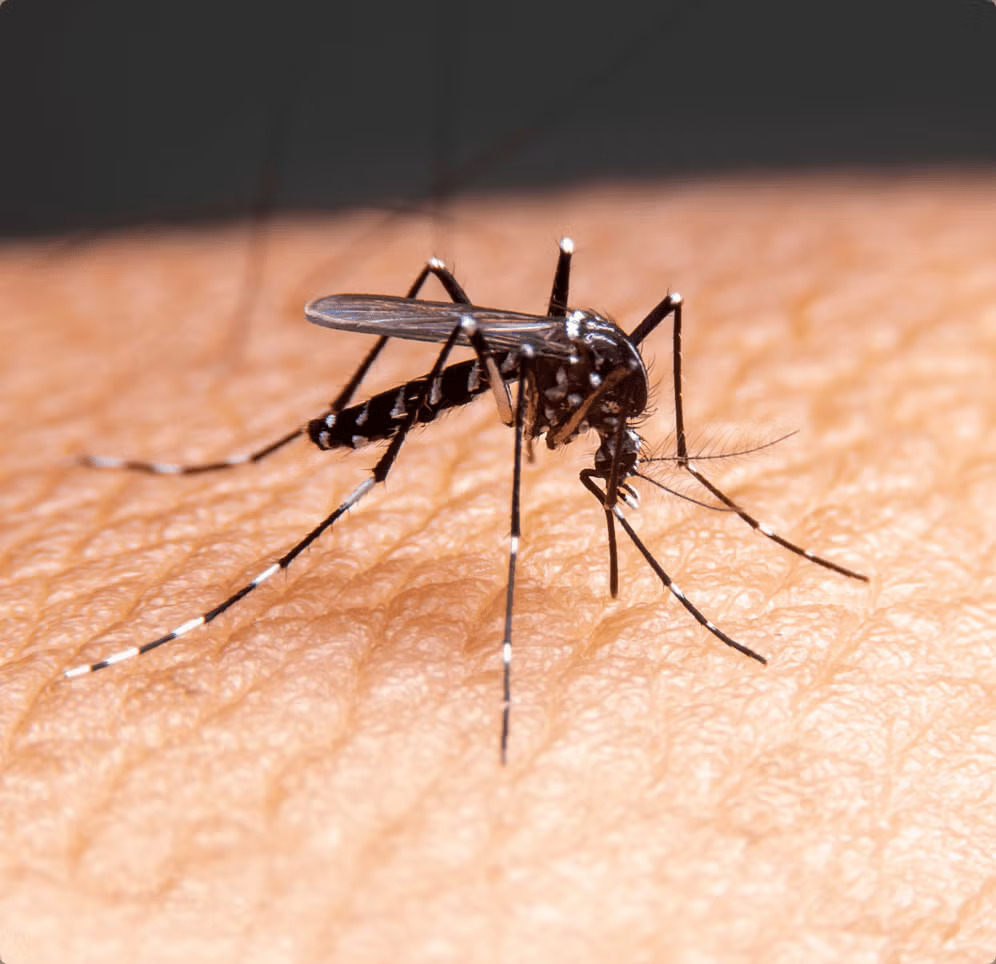
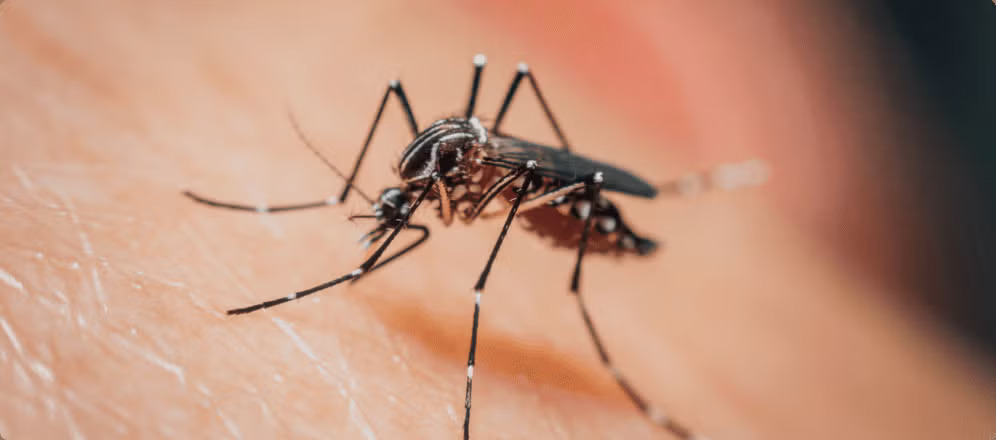
Aedes aegypti, the mosquito that transmits dengue. [1]
Originally from Africa and has been spreading through tropical and subtropical regions around the world since the sixteenth century. [1]
As it is a mosquito that lives close to humans, it is more present in urban areas, especially in regions with a large number of people. [1]
What differentiates it from other mosquitoes are the white stripes on its legs, which are perfectly visible. [2]
Life cycle [3], [4], [5]
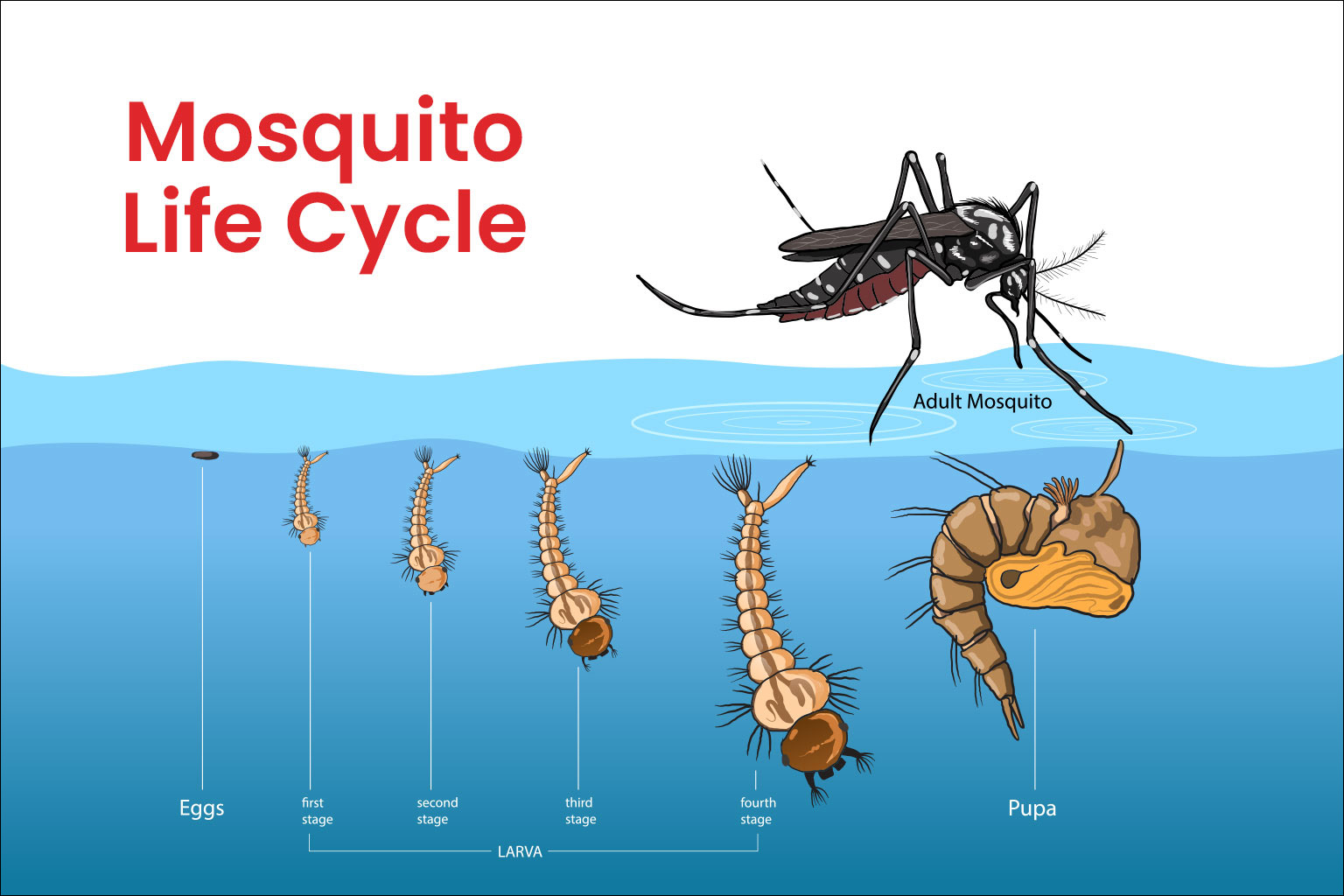
The life cycle of Aedes aegypti, from egg to adult form, varies between 7 and 10 days. It all depends on the temperature, availability of food and the number of larvae existing in the same breeding facility.
This cycle is divided into four phases:
Eggs
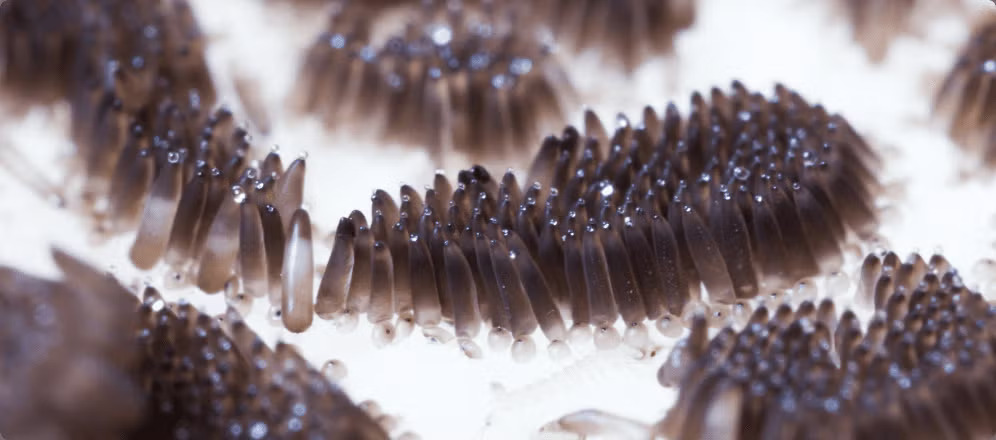
They can last for years and will hatch
when they come into contact with water.
Adult
Once adults, mosquitoes
usually live for 4 to 6 weeks.
Habits
The Aedes aegypti is a domestic mosquito, that is, it lives in or around houses, businesses, schools and churches, for example, and tends to be more often behind curtains, in niches of bookshelves and under tables.
It is most active in the early morning and at dusk, these being the periods of greatest risk of bites. However, it can also bite at night.
The female feeds every 3-4 days, however, if they cannot draw enough blood from the bitten person, they continue feeding until they are satisfied. This is because blood is necessary for the maturation of eggs. [2], [3], [6]
Recognizing the Aedes aegypti
The dengue mosquito has photophobia, that is, it has an aversion to light. Unlike other mosquitoes, both larvae and adults flee from light, moving very quickly when they are illuminated. To be sure if you are facing one of them, do the test using a flashlight. [2]
How it reproduces
The Aedes aegypti reproduces very easily. Mating between the male and female can happen in the first few days after the mosquito reaches adulthood. Once fertilized, the female needs to perform hematophagy, which is nothing more than feeding on blood, so that her eggs can mature in the ovaries.
Normally, spawning takes place in places with clean and standing water, called breeding sites. The eggs are deposited on the walls of several breeding sites, very close to the surface of the water, which ensures the dispersion and preservation of the species. [3], [6]
How the mosquito becomes infected with the virus
Dengue is only transmitted to people through the bite of the infected mosquito. The transmission cycle begins when the Aedes aegypti mosquito bites an already infected person. From there, the virus multiplies in his intestine and infects other tissues, reaching the salivary glands. Once infected, the mosquito is able to continue the transmission of the virus from person to person during its life cycle. [8]
The female is the one who stings
Both male and female mosquitoes feed on nectar, sap, among other substances. However, only the female needs blood for the maturation of her eggs. Therefore, it is the one that bites, since the male does not feed on blood. [3], [7]
C-ANPROM/IN/QDE/0036, Date of Preparation: December 2025
References
-
1. Oswaldo Cruz Foundation. Available at https://www.ioc.fiocruz.br/dengue/textos/longatraje.html Accessed in December 2025
-
2. National Center of Vector Borne Diseases available at https://ncvbdc.mohfw.gov.in/WriteReadData/l892s/52545681531535010918.pdf Accessed in December 2025
-
3. Pan American Health Organization (PAHO). Available at https://www.paho.org/pt/topicos/dengue Accessed in December 2025
-
4. State Health Secretariat of Espírito Santo. Available at https://saude.es.gov.br/Not%C3%ADcia/conheca-as-caracteristicas-do-aedes-aegypti-3#:~:text=Doen%C3%A7as%20como%20dengue%2C%20zika%20e,em%20rela%C3%A7%C3%A3o%20aos%20pernilongos%20comuns Accessed in December 2025
-
5. Oswaldo Cruz Foundation. Available at https://www.ioc.fiocruz.br/dengue/textos/oportunista.html Accessed in December 2025
-
6. Oswaldo Cruz Foundation. Available at https://www.ioc.fiocruz.br/dengue/textos/sobreovirus.html Accessed in December 2025
-
7. Oswaldo Cruz Foundation. Available at https://www.ioc.fiocruz.br/dengue/textos/curiosidades.html Accessed in December 2025
-
8. Oswaldo Cruz Foundation. Available at https://www.ioc.fiocruz.br/dengue/textos/curjosidades.html